Insights into the poetry and life of Ivan V. Lalić, as recalled by his wife and collaborator, Branka Lalić.
Origins
Ivan V. Lalić was born in Belgrade on June 8, 1931, where he lived most of his life. His mother, Ljubica Bajić, was a pianist and daughter of composer Isidor Bajić, and his father, Vlajko Lalić, a journalist. Surrounded by music from childhood, Ivan studied violin for eleven years—an influence that shaped the rhythm and structure of his poetry.
Lalić’s early years were marked by both harmony and loss. The bombing of Belgrade during the Second World War claimed the lives of many of his school friends, leaving him with a lasting sense of survivor’s guilt that echoes throughout his work. He found in Belgrade’s history a mirror for his own life, its tragedies and endurance.
The death of his mother when he was fifteen left a lasting mark on him; their closeness and the impact of her death resonates through much of his writing. Decades later, in 1989, he faced another profound loss when his son Vlajko died in a sailing accident at the age of 29. Themes of death, love, and memory run through his poetry, forming a dialogue between beauty and loss.
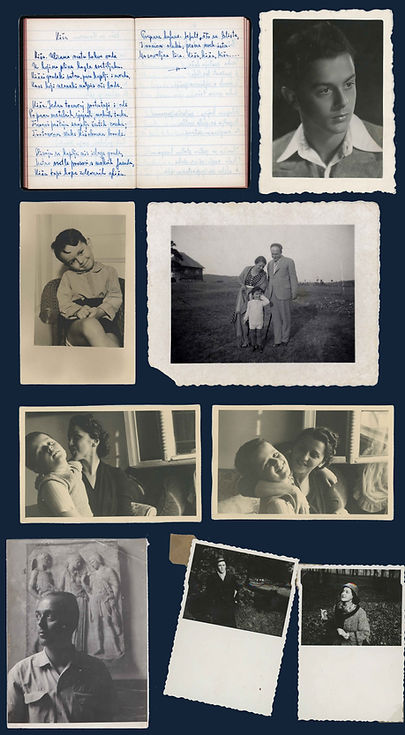
Ivan began writing poetry at a young age, with his earliest surviving notebooks dating to 1945, the year of his mother’s death. That same year, he met Branka Kašnar, the daughter of Dr. Stjepan Kašnar, who had cared for his mother. Branka would become his lifelong companion and an enduring source of inspiration, shaping the emotional landscape of his poetry, especially its reflections on love, memory, and nature.
The Writing Process
What came before almost all of his poems was a great silence. Ivan would shut himself off from everyday life, from all communication. It was a waiting period, allowing thoughts to settle in his mind. That period was sometimes very long, the gap between one poem and the next could last for years. These were periods when he wasn’t actively creating the work, but when the work was creating itself within him. During those times he was very withdrawn and isolated from everyone. The majority of his poems were written at night, while the rest of the day was his time for gathering ideas.
Sometimes, when people asked him questions like “What did you want to say?” or “Why did you write this?”, he would answer, “It was dictated from somewhere—by a higher power, by nature. It merely passed through my mind and found its way onto paper. Nothing I wrote truly belongs to me.” In that sense, Ivan considered himself a kind of medium through whom the poems emerged, guided by his talent, imagination, and deep knowledge of poetry. Ivan read extensively and had great respect for poets from past eras, you’ll find references and quotations from earlier writers in his poetry—Petrarch, Dante, and Jovan Damaskin among them—whom he addressed as if in conversation. From them, Ivan learned how to write poetry.
Recurring Themes
For Ivan, the central themes of his poetry were love, memory, and death. He experienced life and death as two inseparable halves of a single whole. In his view, they stood in the same relationship as day and night: two opposing forces that together form a complete, enclosed cycle. One half is dark, the other light: and within that balance lies the structure of existence. That is how Ivan understood life and death.
His preoccupation with death and memory was rooted in his lived experience. Nothing in his poetry was accidental. The well-known poem Rusty Needle is, in essence, a memorial to his mother and to his friends who were killed. Likewise, Requiem for the 700 Dead in Glina and The Blue Tomb were inspired by historical tragedies, retold through his own vision.
All his life Ivan longed for a daughter. When his second son was born, he felt a profound sense of grief, the sense that with his son’s birth the imagined daughter had died. Ivan locked himself in his study for several days and wrote continuously. And so, an entire cycle of poems was born: “Ten Sonnets for an Unborn Daughter.” The beauty of those verses is so intense, so honest. “Yours is that fence without a house,” he wrote. And at the end of the cycle, he says goodbye: “You are my blood. Farewell, daughter."
As for memory, Ivan’s nostalgia extended not only to his own past but also to the history of his city and country. As I mentioned before, he often saw his own life reflected in that history. His inspiration was above all, Byzantium. Those were the centuries, as he saw them, that formed much of Europe’s spiritual and cultural identity. But I will not go further into a discussion that rightly belongs to scholars.
On the theme of love, you will often find it intertwined with nature. The irony is that Ivan himself was not particularly fond of the outdoors, he preferred to be at home in his study, surrounded by books. I have always felt most at home in nature; it is how I was raised. So, in a way, nature became a metaphor in his poetry; a conversation with me, a reflection of my presence. Of course, there were places we both loved, the island of Maškin in Rovinj, and the Adriatic sea, which always held a deep meaning for him. These images appear again and again in his work. But in truth, Ivan was what one might call an “indoors” person.

5 Letters
In every story of love, there are seasons. Times that begin like December — uncertain, fragile, filled with questions. How will this season end? Will it begin in light, or quietly fade and be forgotten? There is one beautiful movie that portrays this so well, Eternal Sunshine. I wish he could have seen that.
Because all of this, the beginnings, the end, the passing of time, can be found in Ivan’s songs, especially in the cycle 5 letters. They tell of the beginning, the growth, and, in the end, the freshness of love renewed like spring, summer, autumn, and winter.
We used to leave each other letters, to start the day. Ivan would stay up writing late into the night, and I had to leave early in the morning to get to work. I would wake up and look into his study to see if there was a letter on the table. One morning it said: “We have a new song.”
So, while I was sleeping, the nightingale that tormented Ivan still gave way to a fruit. He didn’t sleep because of it’s song. I was up in the early morning, I wrote a new note. That was always the first sign that a beautiful day was about to begin.
After that, I ran to buy newspapers, cigarettes, bread, milk, everything we need for the day. And on the way, I’d pick a rose or a flower in the neighbor’s garden, or in ours, sometimes a strawberry, so that every morning something fresh, something new would come to him. I left the flowers on his desk.

Poems and Places
Many of Ivan’s poems were inspired by his connection with me. For example, the poem Places We Love. To a broader audience, it could relate to any departure from a place where you’ve left something dear, and that is true. But for those who know, the poem is dedicated to me. I am very proud of that.
It was written as we were saying goodbye to our first home together, at Šubićeva 30—the address of our apartment after we married. It was just after the war, during the communist period, when large apartments were rare and two families often shared one flat. We had a single room and a shared bathroom, where I kept a small kettle to make coffee. I was very sad when we had to leave that place, where we spent our first years as a family. Places We Love marks that part of our shared life. And there are many other poems like it, each bound to our personal memories.

Branka on Ivan’s Poetry
If I am completely honest, I would say that almost all the poems Ivan wrote in my presence are, in a sense, our poems. In many of his writings and interviews, Ivan said: “Behind my poems stands my inspiration, Branče.” (My name is Branka, but “Branče” became a habit.) One of his books is even titled To Branče, and that will always mean a great deal to me. These dedications were never merely formal, they were a kind of conversation between us, even when we were together in the same room.
When seeking advice, Ivan often used his favorite expression: he wanted to hear “the first impression of Orpheus’ lyre.” I had the good fortune of being that first listener, because I was always there. He trusted my opinion deeply, not only because I was his wife, but because I was always honest with him. If I didn’t like a poem, I told him so. I wasn’t a professional reader—not in the sense of being involved in literature or poetry—but simply an admirer. I even tried to distance myself emotionally, reading his poems as if they belonged to someone else. That way, I could respond sincerely, without bias.
Beyond my opinion, there were a few others whose judgment Ivan valued most. During his lifetime, one of the most important was Zoran Mišić, perhaps the finest essayist and critic of his generation. After Mišić’s death, he continued to seek the opinions of Aleksandar Jovanović and Jovan Hristić, an exceptional poet and close friend, known to everyone by the nickname Vava. I should also mention Svetlana Velmar-Janković, a highly respected writer in whom Ivan had particular trust. She often read his poems in their earliest forms, and her opinion carried great weight.
Ivan also held literary evenings where his poems were read aloud. Our house was almost always full of friends, writers, and intellectuals—gatherings that lasted late into the night. I was always there, cooking and making coffee for everyone.
However very rarely, almost never, did he change his verses under the influence of others, including my remarks as his first reader. I don’t know whether it’s a good or bad thing when an author changes their text because of someone else’s opinion. I cannot say whether that is a good or bad thing; I’m not qualified to judge. But my inclination is to say no—an author must remain true to his own voice.
I think the question of how much attention Ivan paid to the opinions of others about his poetry is a complex one. I would say that Ivan, like any person, was sensitive. Not to a great extent, but he valued the opinions of those who listened to or read his poetry. Positive opinions from discerning readers, whether they were critics or simply lovers of poetry, meant a great deal to him. But he also accepted negative criticism with a great deal of understanding and reflection. Naturally, it didn’t make him happy, but he appreciated it nonetheless. In fact, he often agreed with critics who had given a negative evaluation of his work, and when a text did receive a negative review, it influenced the future development of his work. Negative criticism, at times, was more welcome and formative to his future writing than any other feedback.
Dreams also played a significant role in Ivan’s life and writing. The dreams he spoke of most often were about his mother. Later in life, they frequently took the form of strange distortions, caricatures of his own poems, their meanings inverted and unsettling. At times, he would wake up, pace the room for a while, and then return to bed, still troubled. Dreams, unfortunately, are quickly forgotten and often take on a very different form from what they actually were. But when a dream disturbed him deeply, whether connected to his life or his poetry, it left a lasting mark. Some of those dreams he never forgot.
Ivan’s relationship to his poems was much like that of a parent to a child. He often said himself, “These poems are my children.” And truly, they were. He felt a profound responsibility for them, a strong emotional bond that was also vulnerable to doubt. There were many moments in his life filled with uncertainty—times when he questioned his own verses, wondering whether he could have expressed something differently, more clearly, more beautifully.
Translation and Influence
Ivan translated extensively—above all from French, German, and English—and he also edited major anthologies. Ivan first worked for the Prosveta publishing house, in its branch Jugoslavija. There he oversaw the production of monographs on various cities and countries, and he had the freedom to develop new editorial series. Among his most successful innovations was the introduction of a science fiction series, beginning with Isaac Asimov, which ran for many years under his editorship and helped popularize the genre in Yugoslavia.
He later launched a music-focused series and, after moving from Jugoslavija–Prosveta to Nolit, became the initiator and chief editor of that program. Around the same period, he was again elected General Secretary of the Writers’ Association of Yugoslavia. He accepted the post without enthusiasm, as he preferred literary work to administration, but he fulfilled the role responsibly. Ivan spoke English, French, and German fluently, and could communicate in Russian and Italian as well. When his term ended, he was eager to return to publishing and writing.
After Nolit could no longer sustain its operations, Ivan chose early retirement and devoted himself fully to translation, even though it was modestly paid. He often said that translating was the same as writing one’s own poetry. He translated from French, German, English, Hungarian, and Italian, often with me. His major works include Leaves of Grass by Walt Whitman, the first complete Serbian translation of the poem, and the poetry of Friedrich Hölderlin, for which he received the Hölderlin Prize. He also co-edited Antologija novije francuske lirike and Antologija moderne američke poezije, alongside me.
I remember he would listen to Hungarian poets, remembering the music of the poem without even understanding what it was about, since he didn’t know Hungarian. Later, he found someone who did and had them translate the text word by word. Then, combining that literal translation with the rhythm and sound he remembered, he created a book translating Hungarian into Serbian. It was very difficult work, but it was well paid at the time.
For Ivan, translation was an act of creative empathy: he identified completely with the author he was translating, becoming both himself and, in spirit, the author whose voice he carried into Serbian. Hölderlin and Whitman were, in that sense, his greatest achievements. Ivan was devoted to literature in all its forms. And to me, he remains alive even now in my heart, perhaps listening and likely criticizing me for speaking about him with too much enthusiasm.
Legacy & Memory
Of course, Ivan always preferred to be referred to as Ivan V. Lalić, with particular emphasis on the “V.” The initial carried deep personal meaning, it honored his father and his son Vlajko, and now even his grandson. It was a name that was a large part of his identity.
Thanks to Aleksandar Jovanović, the best interpreter of Ivan’s poetry from a scholarly and analytical standpoint, and a participant in nearly every public reading Ivan gave, we now have the Collected Works of Ivan V. Lalić. This edition is invaluable, not only for preserving the poems themselves but also for Jovanović’s extensive commentaries and the critical reflections he included from fellow scholars. Such interpretations are essential for any work of art to find its rightful place in public and literary memory.
In Jovanović’s edition, there are several poems that are explicitly noted as having never been published before. Ivan had not included them in any of his official cycles, though some, like Kiša u lišću (Rain in the Leaves), have been often quoted and remembered. Our son Vlajko composed music for that poem. I suggested that, since the poem set to that music sounded like a schlager (a hit tune) that they should publish it, and submit it to television or radio. I know that sounds funny, it makes me smile even now, but perhaps there was a bit of truth in that idea.
I saved all of Ivan’s verses and notes, though I can see that not everything has survived. Over the years and through various moves, some manuscripts were likely misplaced, or deliberately set aside by Ivan himself, to ensure they would not be published without his approval. He was meticulous about what entered the public sphere: nothing was ever printed that he had not explicitly sanctioned.
All of Ivan’s manuscripts have now been recovered from the widow of Aleksandar Jovanović, who held them after his passing. I believe the time has come for these materials to see the light of day. They must be studied for a fuller understanding of Ivan’s process and for the preservation of his legacy.
Contact


Please write to us with any questions, requests, suggestions or criticisms you have to share. Thank you for visiting our website and taking the time to learn about our project!
+1 917-847-9970